Useful Information
Radiation Health
FAQs
(Based on available information as at 14 April 2011)
- What is INES?
- There are many so called "radiation antidote" on sale in the market, are they useful?
- How can you cope with the psychological stress arising from the present event?
- What is the current risk of radiation-related health problems for those people staying in Japan?
- What is the current risk of radiation-related health problems for those people living in Hong Kong?
- How may people be exposed to ionizing radiation?
- What is the meaning of Sievert (Sv)?
- What type of radiation exposure would occur in a nuclear plant accident?
- What are the acute health effects of radiation exposure?
- What are the possible long-term effects from radiation exposure?
- Can radiation spread from person to person? Would contaminated persons transmit the radiation to me/ my fetus ?
- I just travelled back from Japan and did not go to the health desk for radiation check-up, if I feel uncomfortable now, where can I go?
- Does a person who is suspected to have radiation exposure need to be sent to the hospital?
- Can eating salt or applying iodine solution onto the body surface prevent or treat radiation-related injury?
- I am now staying in Japan, should I take iodide tablets?
- Will it affect my baby's health if I switch to another brand?
- How exactly should I change my baby to another brand of formula milk? Is there anything I need to pay special attention to?
- Can I drink the tap water in Japan?
- Will vessels, airplanes included, and cargoes from Japan be radiation-contaminated as a result of the nuclear power plant accident?
- What protective gears are required for workers handling cargoes from Japan?
- Where can we get up-to-date information?
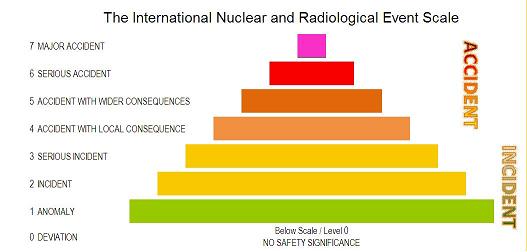
Answer: The International Nuclear and Radiological Event Scale (INES), introduced jointly by the International Atomic Energy Agency (IAEA) and the Nuclear Energy Agency of the Organization for Economic Co-operation and Development (OECD/NEA), is a worldwide tool for communicating to the public in a consistent way the safety significance of nuclear and radiological events.
Events are classified on the Scale at seven levels. Levels 1-3 are called "incidents" and Levels 4-7 "accidents". Those without safety significance are called "deviations" and are classified as "Below scale" / "Level 0".
Answer: There is currently no effective radiation antidote. Iodide tablets are the only pharmaceutical product that provides some form of protection against radiation effects by preventing the uptake of radioactive iodine by the thyroid gland. Iodide tablets should not be used unless it is recommended by a competent public health authority after professional analysis of the emergency situation. There is no scientific evidence to suggest that other commodities, be they foods, drinks, topical products, etc, would have similar radiation protective effect.
Answer: Events like the current Japan earthquake, tsunami and nuclear power plant accident can prove traumatic to some, causing them to have feelings of helplessness, anxiety, anger and even aggression. The following may be helpful –
a) try to follow a normal routine;
b) eat healthy meals, especially take care not to skip meals or overeat;
c) exercise and stay active;
d) help other people in your community as volunteers. Stay busy;
e) accept help from families, friends, colleagues. Share your feelings with them; and/or
f) limit your time around the sights and sounds of what happened. Do not dwell on reports on the tragedy.
However, it is well known that some will take a while before they will feel better and for their life to return to normal. "Give yourself time."
For individuals with the following conditions and whenever in doubt, it is advisable to ask your healthcare professionals for help -
a) not able to take care of yourself or your children;
b) not able to do your job;
c) use alcohol, drugs or substances of abuse to get away from your problems; and
d) feel sad or depressed for more than two weeks.
Answer: Radiation-related health effects are exposure-dependent. In turn, the latter are affected by the type and amount of radiation released from the nuclear power plant; the weather conditions; the proximity to the plant as well as the length of exposure.
Based on available information, Department of Health concurs with the World Health Organizations assessment that the Government of Japan's nuclear emergency response to events at the Fukushima Daiichi nuclear power plant are in line with public health recommendations for protection against radiation exposure. However, as and if the situation changes, the Japanese Government may change their advice to the public. Department of Health is following the situation closely.
Answer: The distance from Hong Kong to Fukushima is around 3000 km. As there is strong dilution effect due to the current climatic situation and the long distance, the current risk of radiation-related health problems to people living in Hong Kong is considered to be very minimal. In any case, the Government is closely monitoring the situation in Japan and assessing its impact on Hong Kong.
Answer: People are exposed to the natural radiation in the environment (background radiation). Apart from this, they can commonly acquire radiation externally through skin deposition, medical procedures such as X-ray or internally through breathing or eating. People can be exposed to ionizing radiation through contamination of wounds.
Answer: Radiation dose absorbed by human body are expressed in units of Sievert(Sv). On average, a person is exposed to approximately 3.0 mSv/year (1 mSv = 1/1000 Sv) of which, 80%(2.4mSv) is due to naturally-occurring sources (i.e. background radiation), 19.6%(almost 0.6mSv) is due to the medical use of radiation and the remaining 0.4% (around 0.01mSv) is due to other sources of human-made radiation.
In some parts of the world, levels of exposure to natural radiation differ due to differences in the local geology. People in some areas can be exposed to more than 200 times the global average.
Answer: A nuclear plant is safe when it is functioning properly. It causes risk to the health of people only when there is an accident involving damage to the nuclear reactor causing leakage of radioactive materials, mostly radionuclides. Radioactive materials in the reactor core may be released into the atmosphere with a mixture of products generated inside the reactor ("nuclear fission products"). Radioactive caesium (Cs-137) and radioactive iodine (I-131) are the most abundant radionuclides that may be released into the atmosphere during an accident. The severity of the risk so caused will depend on the geographical and weather situation of the nuclear plant and the amount and type of radionuclide released.
Answer: If the dose of radiation exposure exceeds a threshold level, it can produce acute health effects such as skin redness, hair loss, radiation burns and acute radiation syndrome. However, the general population is not likely to be exposed to doses high enough to cause these effects. Rescuers, first responders and nuclear power plant workers are more likely to be exposed to doses of radiation high enough to cause acute effects.
Acute radiation syndrome is a set of signs and symptoms that may develop after whole-body doses above 1 Sv (i.e. about 300 times the annual dose to background radiation). It is mainly related to the damage of the bone marrow, where the blood cells are produced. At higher doses (>10 Sv), other organs may be affected (e.g. gastrointestinal, cardiovascular).
Answer: Exposure to radiation can increase the risk of cancer. Radioactive iodine can be released during nuclear emergencies. If breathed in or swallowed, it will concentrate in the thyroid gland and increase the risk of thyroid cancer. The risk of thyroid cancer following radiation exposure is higher in children and young adults.
In very extreme situations, such as among Japanese atomic bomb survivors, the risk of leukemia increased a few years after radiation exposure, whereas the risks of other cancers increased more than 10 years after exposure.
Answer: Unless one was in the close vicinity of the Fukushima Daiichi Nuclear Power Plant, otherwise, the chance of radiation exposure could only be minimal. For whatever small amount of contamination, it would usually be sufficient to wash away the radioactive contaminants by changing clothes and rubbing with soaps and have showers.
Answer: People who still have doubts about their health can go to the Accident and Emergency Department of any public hospital for medical advice.
Answer: People who still have any doubt about their health can go to the Accident and Emergency Department of any public hospital for medical advice.
Answer: There is no scientific evidence that eating salt or applying iodine onto the body surface can prevent or treat radiation-related injury. 85% of salt available in Hong Kong is not iodized and the iodine content of iodized salt is low. Moreover, one has to take about 2.5 to 5 kilograms of iodized salt a day in order to absorb the equivalent dose of iodine that is contained in an iodide tablet. Consuming an excessive amount of salt is harmful to health especially for those with high blood pressure, heart disease or kidney disease. Applying iodine solution onto body surface may cause skin irritation.
Answer: Iodide tablets are not radiation antidotes. They do not protect against external irradiation or any other radioactive substances besides radioactive iodine. When there is a nuclear plant accident, iodide tablets are given to people likely to be exposed, especially nuclear plant workers and rescuer, to saturate their thyroid glands so as to prevent the uptake of radioactive iodine released from the accident. The drug must be given before or shortly after an exposure for the prevention of thyroid cancer in the long term. It is a universal consensus among the World Health Organization and all leading public health authorities that only after professional analysis of the emergency situation will a competent public health authority be in a position to recommend the use of iodide tablets.
Answer: Standard infant formula milk is essentially cow's milk based and manufactured with reference to the nutritional content of breast milk. As manufacturers have to adhere to international or national standards of infant formulae, they are very similar in composition.
In general, healthcare professionals would not recommend parents to switch their babies to another brand for minor problems. Yet, if there are genuine needs, switching to another brand should not affect babies' health.
It is, however, important that parents ought to choose the appropriate formulae for their babies. Specifically, for children-
a) from birth to 6 months –
For babies taking cow milk-based infant formula (for 0-6 months), you can change directly to another brand of cow milk-based infant formula. However, you should not switch to high protein "follow-on formula" (for 6 months or above) as this will overload your baby's kidneys, leading to dehydration, gastroenteritis and even brain damages;
b) 6-12 months –
You can continue to feed your babies with infant formula (for 0-6 months) or follow-on formula (for 6-12 months).
At around 6 months, babies should start to take complementary foods. In the beginning, milk still remains as the main source of nutrients. However, when your children consume substantial amounts and varieties of other foods, the amount of milk intake can be decreased gradually. Regular cow's milk is not recommended for infants less than 1 year old;
c) 1 year or beyond –
By 1 year old, your children should be enjoying a balanced diet, with a good variety of solid foods that replaces milk as the main source of nutrients. Your children can drink whole (full-fat) milk, such as chilled pasteurized cow's milk or UHT milk;
d) on special formulae –
You should seek advice from attending doctor, nurses, midwives or dietitians.
Answer: Different brands of formula milk have different dilution methods. Therefore, it is definitely against recommendation for parents to mix two or more brands of milk powder when preparing one feed.
There is actually no fix rule on how to switch formula milk. The pace will depend on individual baby’s acceptance. As the taste of different formulae does differ, it is not unexpected that some children may need more time to adapt. Parents can increase the number of feeds of the new brand gradually. If everything goes smoothly, you can adopt a faster pace until all feeds are replaced by the new brand.
Another piece of advice: Parents may notice a change in their children’s bowel habits, whether in terms of frequency, texture and/or colour of the stool. This is accountable and acceptable as the amount of additives like iron, prebiotics, etc, does vary amongst the different brands. Parents should not be over-worry and try to switch to a third brand. In fact, if children do not have allergy to the original cow milk-based formula, it is unlikely that they will develop allergy on switching to another cow milk-based formula.
Answer: In response to concerns about the safety of drinking water in Japan, World Health Organization (WHO) advised that drinking tap water poses no immediate health risk, but local conditions will differ and may fluctuate. Essential hydration of infants should not be compromised in an attempt to reduce radiation exposure. WHO urges people in the area to heed the advice of local authorities, as they will have access to the latest measurements of radiation levels in water to compare against the standards for adults and children. These standards are precautionary and the presence of some degree of radioactivity in tap water does not mean that it is unfit for human intake. Short term consumption does not pose a significant threat to health because it would take long-term exposure to these levels of radiation to generate adverse health effects.
For radiation health protection, the most fundamental principle is control at source. In this regard, it is reassuring to learn that the Japanese authority has already imposed a no-entry zone for transport of 30km from the Fukushima Daiichi Nuclear Power Plant. This means that vessels can only travel in air or water space that is considered free of harmful levels of radioactive contaminants.
Indeed, the International Civil Aviation Organization, on behalf of respectively the International Atomic Energy Agency, the International Maritime Organization, the World Health Organization and the World Meteorological Organization, has issued a joint statement on the continued safety of international transport operations in Japan. These five organizations confirmed that at present, there is neither the need to impose other restriction on Japan for normal international transport operations or screen vessels or cargoes leaving the country.
Afterall, given that the infrastructure and logistics in Fukushima and its vicinity is severely damaged by the earthquake, the tsunami and the ongoing nuclear accident, and the top priority there is on rescue and relief, it is most unlikely that cargos are being packed and leaving from such high risk areas.
Before addressing the question, one must understand how people get exposed to radiation. We can do so either from sources outside or inside of our body.
In the present case, external irradiation can be produced when radioactive materials, whether as aerosol, dust or liquid become attached to the skin or clothes.
However, unless a cargo has come from the evacuation zone in Fukushima and without proper decontamination, the risk of cross-contamination from such a piece has to be very remote, if any.
Besides, external contamination can be dealt with by change of clothes or covering, and washing off with water and soap.
Internal contamination may result from breathing in, swallowing radioactive materials or through contamination of wounds. Again, it is highly unusual for a cargo handler to acquire internal contamination by handling cargoes. This low risk can further be controlled by diligent observation of personal hygiene.
Specifically on personal protective clothing, good protective practice requires that the degree of protection ought to commensurate with the degree of risk.
As the risk of exposure for cargo handlers in Hong Kong is assessed to be almost negligible, it follows that no special personal protective equipment is indicated.
Nonetheless, the importance of good personal hygienic practice cannot be over-emphasised. This includes timely hand washing and change of uniforms, and showering after work. Workers should report to their supervisors if they detect anything suspicious or are in doubt.
The Department of Health is monitoring developments in Japan carefully in order to assess its impact on public health. Information on this site will be updated whenever necessary.
Related Sites
- Security Bureau - Daya Bay Contingency Plan of The Hong Kong Special Administrative Region
- Security Bureau - Daya Bay Contingency Plan of The Hong Kong Special Administrative Region (Useful Links)
- Centre for Food Safety - New Arrangement for Import Control on Japanese Food
- Hong Kong Observatory - Radiation Monitoring
- Hong Kong Observatory - Radiation Measurement Results of Sea Water Samples in Hong Kong Waters
- Agriculture, Fisheries and Conservation Department - Radiological Testing of Fishery Products